


Near-Miss Prevention at Warehouse Doors and Loading Docks: Turning Close Calls Into Corrective Action

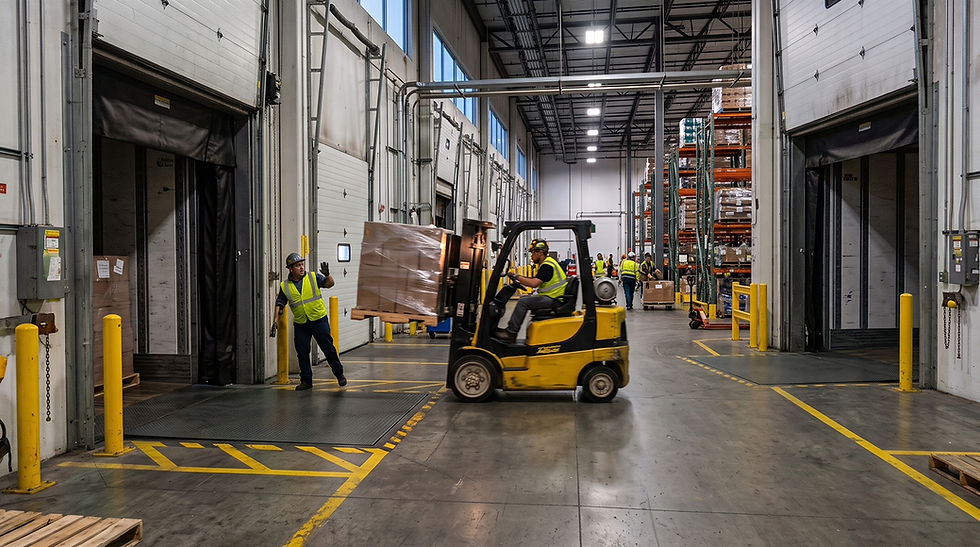
A forklift operator rounds the corner near a loading dock just as a warehouse associate steps out from behind a stack of pallets. Both react in time. The forklift stops six inches short. The associate jumps back. Nobody is hurt, nobody files a report, and within an hour both workers have moved on to the next task. By the end of the week, neither of them remembers the exact details.
This is the single most common safety event in warehouses and distribution centers, and it is also the most consistently ignored. A near miss is not a non-event. It's a free warning that something in the facility's layout, lighting, or traffic pattern is set up to eventually produce a real injury.
Facility managers who have worked an incident investigation after a serious forklift-pedestrian collision or a dock-related injury almost always find the same thing in hindsight: the exact scenario had happened before, minus the injury. The pattern was there. Nobody caught it because nobody was capturing it.
The Numbers Don't Lie
Safety researchers have used different ratios over the years, but the underlying relationship has held up across decades of incident data: for every serious injury at a facility, there are dozens of near misses and unsafe conditions that preceded it. Some versions of the ratio put it around 1 serious injury for every 30 minor incidents and 300 near misses. The exact numbers vary by industry and study, but the direction never changes near misses vastly outnumber actual injuries, and they are the leading indicator that shows up first.
For a warehouse or distribution center, that means the two or three "we were lucky" moments that happen at your loading dock doors and overhead doors every week are not background noise. They are the earliest, cheapest, and least painful opportunity to fix a hazard before OSHA, workers' comp, or a lawsuit gets involved.
The real cost of ignoring near misses isn't abstract. It's the recordable injury that eventually happens at the same door, in the same blind spot, during the same shift-change rush the one that triggers an OSHA 300 log entry, a workers' comp claim, and in some cases an OSHA inspection that goes well beyond the single incident. Insurance carriers increasingly ask about near-miss reporting programs during underwriting reviews, and facilities that can't show a process for capturing and acting on close calls often pay for that gap in higher premiums.
Where the Risk Lives
Near misses at industrial doors and loading docks cluster around a small number of predictable locations, which is exactly what makes them preventable.
Overhead doors and dock doors create blind corners on both sides a forklift or pedestrian approaching from one side has no visibility into what's coming from the other until they're already in the doorway. Add a stack of pallets, empty totes, or a parked pallet jack near the opening, and the blind spot gets worse.
Shift change and break periods are when near misses spike. Foot traffic increases sharply as workers move between the floor, break rooms, and parking areas, often crossing directly through forklift travel lanes and dock door thresholds at the same time equipment operators are trying to finish their last loads.
Doors that cycle frequently high-traffic overhead doors, dock doors during peak receiving hours create a moving hazard that's different every time. A door that's closed one moment and swinging open the next removes the visual cue that would normally tell a pedestrian or operator to slow down.
And critically: most of these near misses go unreported. Workers don't want to fill out paperwork for something that "didn't happen." Supervisors don't always ask. Without a mechanism that captures the event automatically or makes reporting frictionless, the data that would flag the hazard simply doesn't exist.

How LED Warning Systems Address This
The most effective near-miss prevention doesn't rely on workers remembering to report a close call after the fact it removes the conditions that create the close call in the first place, and it does that by making the hazard visible before anyone gets close enough for it to matter.
BrinkAlert's Commercial Door Light Kit (CDLK) and Loading Dock Light Kit (LDLK) mount LED strips directly on the door frame or dock structure, giving every approach to the doorway an unmistakable visual signal. When a door is opening, closing, or a forklift is approaching from the blind side, the LEDs shift to an active warning state typically flashing amber or red so that anyone approaching from either direction gets the same warning at the same time, without needing a line of sight to the other side.
This matters for near-miss prevention specifically because it changes the moment where the "close call" would have happened. Instead of a pedestrian and a forklift discovering each other at the doorway, both see the warning light activate before they're in each other's path. The near miss that would have gone unreported never gets the chance to happen it gets resolved as a normal, uneventful pass instead.
The kits tie into a facility's existing door controls and dock equipment, so the warning state activates automatically based on door position or leveler activity, not on a worker remembering to press a button. That reliability is what makes it a genuine engineering control rather than an administrative one it doesn't depend on training compliance or memory under pressure.
Facility Spotlight
At a regional grocery distribution center running three shifts, the safety team had noticed something in their monthly toolbox talks: workers kept mentioning "close calls" near the receiving dock doors, especially during the 2 p.m. shift overlap when incoming staff crossed paths with outgoing staff right at the dock thresholds. None of it had ever been formally logged, but the pattern kept surfacing anecdotally.
The facility installed Loading Dock Light Kits across its six primary receiving doors, syncing the LED strips to each door's open/close cycle and dock leveler position. Within the first month, supervisors reported a noticeable drop in the near-miss comments coming up in shift huddles. More importantly, the visual cue gave workers a shared reference point — instead of relying on shouted warnings or assuming the other person had seen them, the flashing LED strip made the hazard state obvious to everyone in the area at once, forklift operators and pedestrians alike.
Where Facilities Fall Short
Most facilities that struggle with near misses aren't ignoring safety they're relying on approaches that were never built to catch the problem.
Treating near-miss reporting as optional paperwork is the most common mistake. If reporting a close call takes five minutes of writing an incident description that goes into a filing cabinet, workers will stop doing it within a month, especially if nothing visibly changes as a result.
Relying on horns and beacons that everyone has tuned out is another. Standard backup alarms and strobe lights blend into the ambient noise of a busy warehouse. Workers stop registering them as meaningful signals, which defeats the purpose of having a warning system at all.
Assuming training alone will fix a layout problem is a persistent error. No amount of forklift certification changes the fact that a blind corner at a dock door has zero visibility. Training helps operators react faster once they see a hazard it doesn't give them sight lines they don't have.
Waiting for an injury to trigger a hazard review means the facility is only ever reacting to the worst-case outcome of a pattern that had been visible for months in the form of ignored near misses.
Not tying corrective action to a specific location is a subtler mistake. If near misses are logged generically ("forklift-pedestrian incident") without noting the exact door or dock bay, facilities lose the ability to see that 80% of their close calls are happening at the same two doors.
Questions We Hear Often
What counts as a near miss at a loading dock or warehouse door?
Any event where a collision, fall, or equipment strike almost occurred but didn't a forklift braking hard to avoid a pedestrian, a worker stepping back from a swinging door, a trailer pulling away before a restraint was fully engaged. If it could have caused injury under slightly different timing, it qualifies.
Does OSHA require near-miss reporting?
OSHA doesn't mandate a formal near-miss reporting program in the way it mandates recordkeeping for actual injuries (29 CFR 1904), but a documented near-miss process is widely recognized as a best practice and is often reviewed favorably during OSHA consultations and insurance audits.
How do LED warning systems reduce near misses if people are already careless?
They don't rely on attentiveness at all that's the point. The warning is visible whether or not someone is paying close attention, which is exactly the scenario where near misses happen: a momentary lapse, not a habitual disregard for safety.
Can these light kits be retrofitted onto existing doors?
Yes. BrinkAlert's Commercial Door Light Kit and Loading Dock Light Kit are designed to integrate with most existing overhead door and dock leveler control systems without requiring a full door replacement.
What's the fastest way to start reducing near misses at our facility?
Start by identifying the one or two doors or dock bays where near misses or "close call" comments come up most often in shift talks, then address that specific location with a visual warning system before expanding facility-wide.
Do these systems work in facilities with multiple shifts and varying light conditions?
Yes. LED strips are visible in both bright daylight dock conditions and low-light night shifts, which is part of why they outperform static signage that depends on ambient lighting.
Putting It All Together
Near misses are the cheapest safety data a facility will ever generate — free warnings that show up before an injury does, not after. The problem isn't a lack of near misses; it's that most of them disappear the moment they happen because nothing was in place to catch them or prevent the conditions that caused them.
Visual warning systems like BrinkAlert's Commercial Door Light Kit and Loading Dock Light Kit don't just make it easier to notice a hazard they remove the blind-corner and low-visibility conditions that produce near misses at doors and docks in the first place. That's the difference between managing a growing incident log and never generating one at that location again.