


Manual Door Light Kits: Visual Safety for Manually Operated Commercial Doors

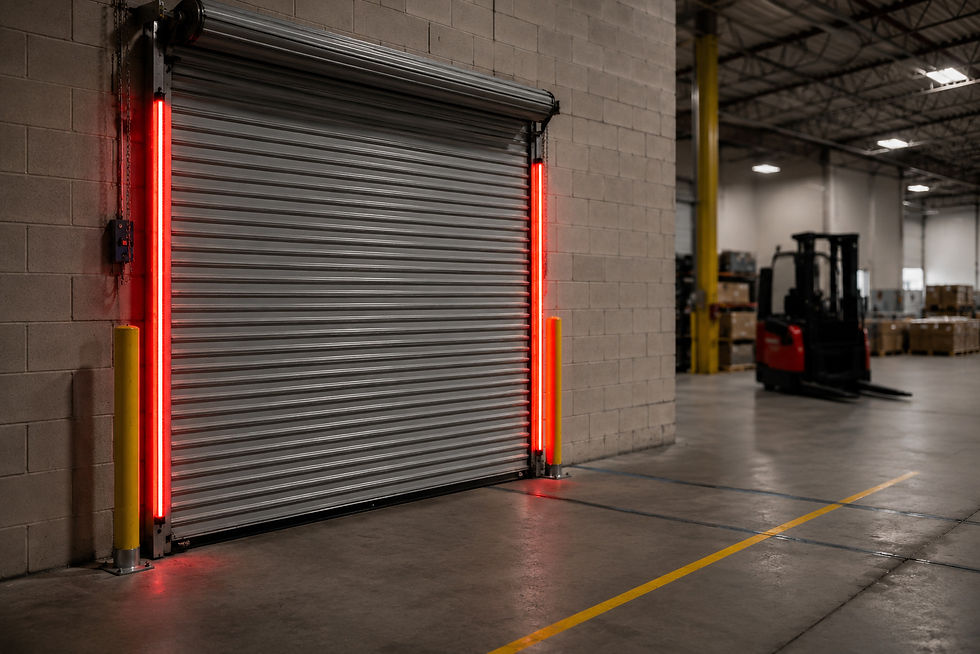
Not every commercial door runs on a motor. Across warehouses, distribution centers, fire stations, manufacturing plants, and municipal facilities, thousands of manually operated overhead and rolling steel doors open and close every day lifted by hand, lowered by chain, cycled by workers who may or may not know what's on the other side.
That's the problem. A manually operated commercial door offers no built-in signal to the people around it. No door sensor, no motor interlock, no automated warning system. When a door is down, workers on the approach side can't see through it. Workers on the interior side may not hear activity outside. And workers elsewhere in the facility have no way to know whether the door is open or closed without physically going to look.
BrinkAlert's Manual Door Light Kit (MDLK) was designed specifically for this gap. It brings the same red/green LED visual signaling proven on automated commercial doors to manually operated doors giving workers, forklift operators, and equipment at these doors a clear, visible status indicator without requiring any connection to a motor or opener.
Why This Matters
Manual doors see the same traffic as automated ones. In many facilities, they see more because manual doors are often installed in secondary access points, storage areas, and service bays where the budget didn't support an automated opener, but the safety risk is just as real.
The hazards that come with manual overhead doors are predictable:
Workers approach a closed door from outside with no visibility inside. A delivery driver, contractor, or employee walking up to a manual bay door doesn't know whether a forklift is parked just inside, whether the floor is clear, or whether the door is about to be opened from the inside.
Workers on the interior have no signal that someone is about to open the door from outside. If a manual door is lifted from the outside, workers positioned near the door have no advance warning.
Forklift operators approaching a manual door have reduced stopping distance. A reach truck or counterbalance forklift moving toward a closed manual door has to slow well in advance if the operator doesn't know the door status. Without a visual signal, many don't.
After-hours and low-staffing shifts amplify the risk. During periods when fewer workers are present, communication about door status is informal or nonexistent. This is exactly when incidents are most likely.
OSHA 29 CFR 1910.178 requires employers to establish safe speeds for industrial trucks near door areas and to ensure adequate lighting and visibility at transition points. For manually operated doors where visual warning controls aren't built in, the MDLK is a straightforward engineering solution to a recognized hazard.
The Safety Problem
The core problem with manual commercial doors is that they're passive. An automated door wired to a controller can trigger a warning light, flash a beacon, or sound an alert when the door cycles. A manual door does none of that. It opens when a person lifts it and closes when a person lowers it, with no signal to anyone who isn't watching.
In a facility where a manual door is used infrequently, this is a manageable risk. But in any facility where manual doors see regular traffic multiple cycles per shift, workers moving in both directions, equipment operating nearby the absence of a status signal creates a consistent exposure.
Vision panels help in some configurations, but many manual rolling steel doors don't have them. Even when they do, a small window at eye level doesn't communicate door status to a forklift operator 40 feet away or a worker in a staging area with a sight line obstructed by racking.
The missing piece is a visible, always-on status indicator that communicates door state to everyone in the area not just the person standing directly in front of the door.

How the BrinkAlert Manual Door Light Kit Solves It
The MDLK installs on the door frame of a manually operated commercial overhead or rolling steel door and provides a continuous LED status signal: solid red when the door is closed, solid green when the door is open.
This simple two-state signal communicates critical information to everyone in the vicinity:
A forklift operator approaching from across the building can see the door is closed and adjust speed and path accordingly.
A worker inside the facility can see that a door is open and knows to expect traffic through that opening.
Workers outside can see the green light and know the door is clear for entry or delivery.
Supervisors can confirm door status at a glance from a distance.
Because the MDLK is designed for manually operated doors, it doesn't rely on a motor signal or automated controller. The system uses a simple activation mechanism; a push button, 2 or 3-way switch, or other manual trigger that the worker operating the door engages when opening or closing. The LED strips update to reflect the new door state.
LED strip format
Vertical strips mounted on the door frame provide wide-angle visibility from multiple approach directions not just head-on.
Red/green color logic
Red signals closed; green signals open. The same color language used in traffic control, dock lights, and industrial signaling systems. Workers understand it immediately without training.
Designed for retrofit
The MDLK is built to install on existing manual commercial doors. It doesn't require structural modification to the door, the frame, or the building. It connects to a standard electrical supply and mounts to the door frame using standard hardware. This makes it viable for older facilities, secondary access points, and any location where a full automated door system isn't practical.
Industrial construction
BrinkAlert products are built for the environment where manual commercial doors actually live temperature swings, vibration, dust, and occasional impacts. The components are rated for industrial use, not office environments.
The result is a manual door that communicates its status to the entire facility the same functional information a dock light or traffic signal provides at an automated door, applied to a door that has never had that capability before.
Real-World Application
Consider a regional fire station with three apparatus bays. Two of the bays have motorized overhead doors tied to the alerting system when a call comes in, the doors open automatically as apparatus roll. The third bay has an older manual door that was left in place during a partial renovation because the opening is used primarily for equipment storage and occasional vehicle access.

That third bay sees less traffic than the motorized bays, but it's not low-risk. During drill preparation, department vehicles maneuver in and out. Contractors and delivery personnel approach the bay from the apparatus apron. And because the bay is on the side of the building away from the main apparatus floor, workers inside don't always have a clear sightline to the door.
After installing the MDLK, the door frame carries a continuous green or red signal visible from the apparatus apron, the side parking area, and the interior equipment storage zone. Firefighters and contractors approaching the bay can see at a glance whether the door is up or down. Workers inside can see the signal change when someone opens the door from outside.
The same logic applies to a distribution center with a secondary receiving door that's manually operated, a manufacturing plant with a maintenance bay that sees infrequent but not low-risk traffic, or a municipal public works facility where vehicles and personnel share a manual-door access point.
Common Mistakes Facilities Make
Assuming manual doors are low-risk because they're used less
Frequency and risk are different variables. A manual door that cycles 10 times a day in an uncontrolled environment can be more dangerous than an automated door that cycles 100 times with a proper safety system. Lower frequency doesn't mean lower consequence.
Relying on verbal communication for door status
"Call me when the door is open" works until someone forgets, the radio is busy, or noise makes communication unreliable. Status lighting is a passive, always-on control that doesn't depend on anyone remembering to communicate.
Skipping safety upgrades on non-primary doors
Secondary and auxiliary doors often miss the safety investment that goes into main dock doors and primary access points. But incidents at secondary doors are just as real and just as costly.
Treating floor markings as sufficient warning
A painted caution arc on the floor marks the hazard zone but says nothing about current door state. The arc is the same whether the door is open, closed, or actively being cycled. Status lighting conveys real-time information that floor markings cannot.
Waiting for an incident to justify the upgrade
Manual door incidents are common and largely preventable. Facilities that install the MDLK proactively avoid the workers' comp claims, OSHA scrutiny, and operational disruption that come after an incident not before.
Frequently Asked Questions
Does the MDLK require a connection to the door's hardware or motor?
No. The MDLK is specifically designed for manually operated doors that have no motor or automated opener. It uses a manual activation mechanism a push button or similar control operated by the person cycling the door. No motor integration is required.
What commercial door types is the MDLK compatible with?
The MDLK is designed for manually operated commercial overhead and rolling steel doors — the type found in secondary bays, equipment storage areas, fire stations, light industrial facilities, and service entrances. It is not designed for automated doors wired to a controller; BrinkAlert's Commercial Door Light Kit (CDLK) covers those applications.
How far away are the LED strips visible?
BrinkAlert LED strips are visible from 30 feet or more in standard industrial lighting conditions. Visibility range increases in lower-ambient-light environments. Mounting height and angle affect the visible range at specific installations.
How difficult is installation?
Installation is straightforward for a qualified electrician or maintenance technician. The kit mounts to the door frame and connects to a standard electrical supply. No specialized door hardware expertise is required. For facilities with an existing commercial door dealer or installer, the MDLK can typically be added to a standard service visit.
Can the MDLK be installed on fire station apparatus bay doors?
Yes. Fire station apparatus bay doors are one of the primary applications for the MDLK, including manual bay doors at stations where some or all bays have not been converted to automated openers. The red/green signal is clearly visible from the apparatus apron and provides status communication for both vehicle and personnel approach.
Does BrinkAlert offer a version for automated commercial doors?
Yes. The Commercial Door Light Kit (CDLK) is designed for motorized commercial overhead doors and connects to the door's existing wiring to provide automatic status indication without a manual trigger. If you have a mix of manual and automated doors at your facility, BrinkAlert has products for both.
Manually operated commercial doors aren't second-class hazards just because they don't have motors. They're access points where workers, equipment, and vehicles converge and where the absence of any status signal leaves everyone operating on assumptions.
The BrinkAlert Manual Door Light Kit gives those doors a voice. A red signal that says "door is closed don't assume what's on the other side." A green signal that says "door is open — traffic is moving through here." Simple, visible, industrial-grade communication that works at the scale of a warehouse floor or a fire station apron.
If you have manually operated commercial doors in your facility, you have this risk. The MDLK is built to address it.
Ready to Improve Safety at Your Facility?
Contact BrinkAlert to discuss your facility's door safety needs and get a quote for the Manual Door Light Kit.
📧 sales@brinkalert.com or call (786) 339-9840