


Loading Dock Warning Lights: What OSHA's Warehouse Emphasis Program Means for Your Facility


In March 2026, a worker at a Rivian warehouse in Normal, Illinois, was fatally pinned between a semi-trailer and the dock face. OSHA opened a formal investigation. Safety managers at warehouses and distribution centers across the country went back to their loading dock checklists. The incident was a stark reminder of a risk that doesn't get enough attention: the loading dock is the most dangerous area in any warehouse or distribution center. OSHA's National Emphasis Program on Warehousing and Distribution Center Operations (CPL 03-00-026) is actively directing inspectors toward exactly these areas. If your facility has loading docks, this program affects you, and your warning light systems are among the first things inspectors look for. This guide covers what the OSHA NEP means for your dock, what warning light systems are required and recommended, and what a compliant dock setup looks like in practice.
Why This Matters
The numbers around loading dock safety are sobering.
According to OSHA, 25% of all warehouse accidents occur at or near the loading dock. Industry safety research puts the near-miss ratio at approximately 600 unreported incidents for every recorded injury, revealing how frequently workers come close to serious harm without it ever appearing in a report.
Between 2015 and 2020, according to Bureau of Labor Statistics data, roughly 33,000 U.S. workers missed work due to loading dock injuries, and 49 workers died during that same period. The National Safety Council estimates the financial toll at approximately $675 million per year across the industry, with average per-injury costs reaching $191,000.
These are not abstract statistics. They reflect the operational reality of an environment where 80,000-pound trucks, pedestrians, forklifts, and open dock edges coexist within feet of each other, often with no reliable communication system in place.
The Safety Problem: Why Loading Docks Are So Dangerous
Loading docks concentrate multiple hazard types into a compact, high-traffic space.
Pedestrian and vehicle conflict. Workers on foot share the dock apron with backing trucks and moving forklifts. Sight lines are limited. Noise from trucks, dock levelers, and warehouse equipment drowns out verbal warnings.
Trailer creep and drive-away accidents. A truck driver who doesn't know loading is still in progress may pull away from the dock with a forklift or worker partially inside the trailer. Trailer creep is the gradual forward movement of an unsecured trailer during loading. It creates a growing gap between the trailer floor and the dock leveler that can swallow equipment or people.
Open dock edges. When a bay door is up and no trailer is docked, the edge is an unguarded drop of 48 inches or more. Forklifts have driven off open dock faces. Workers have fallen.
Visibility failures. Dock workers inside the trailer cannot see the dock approach. Truck drivers cannot see the dock face. Warehouse workers cannot see whether a trailer is secured or a bay is clear. Communication breaks down, and that breakdown is where most accidents begin.
Most of these problems share a root cause: there was no reliable visual signal telling everyone in the area what the current status of the dock was.
The Technical Explanation: How Loading Dock Warning Light Systems Work
A loading dock warning light system replaces guesswork with clear, unambiguous visual communication. The core concept is a red and green signal that tells truck drivers, dock workers, and anyone approaching the dock whether it is safe to move, load, or enter.
Interior dock lights face into the warehouse and communicate bay status to forklift operators and dock workers. Exterior dock lights face the truck apron and communicate directly with drivers.
A fully integrated system operates like this:
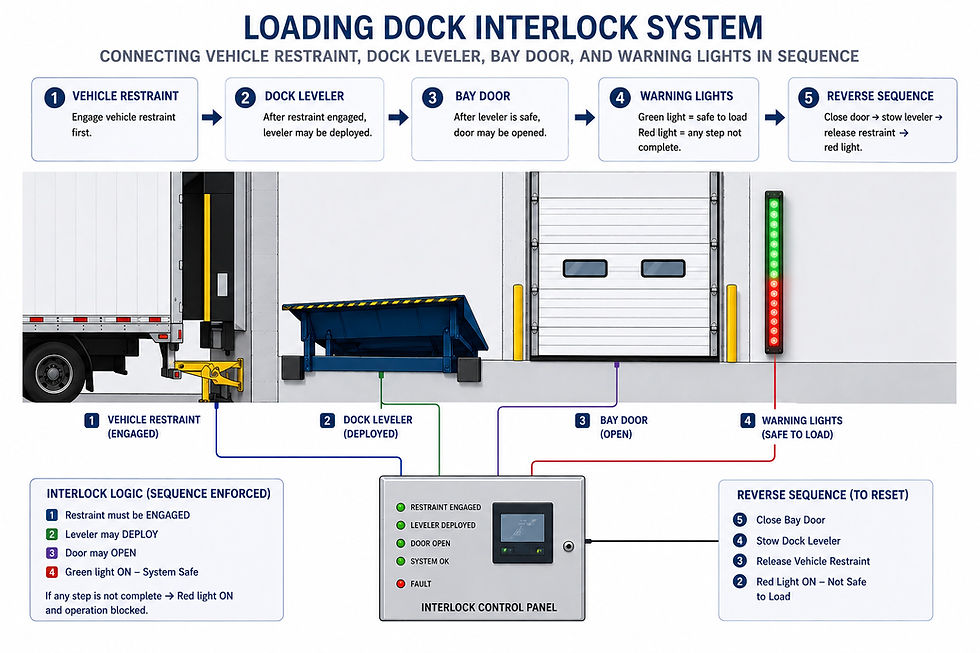
1. A truck backs into the bay and is secured by a vehicle restraint.
2. The restraint's engagement triggers the exterior light to turn red (truck must stay) and the interior light to turn green (workers may enter).
3. When loading or unloading is complete and workers have cleared the dock, an operator changes the signal: exterior turns green (driver may pull away) and interior turns red (forklift operations at this bay must stop).
More advanced systems interlock the dock light with the bay door, the dock leveler, and the vehicle restraint in a sequenced controller. The door cannot open until the restraint is engaged. The interior green light cannot activate until the door is open and the restraint is confirmed. Each step in the sequence must be completed before the next is authorized, eliminating the most common causes of drive-away and trailer-fall accidents.
LED technology has become the standard for dock warning lights. LEDs deliver the brightness needed for visibility across a noisy, active dock environment, last significantly longer than incandescent alternatives, and operate reliably in the temperature extremes common in dock environments, especially in cold storage and food processing facilities.

Relevant Standards and Best Practices
OSHA 29 CFR 1910.178 requires that powered industrial truck traffic be managed to protect pedestrians, that permanent aisles and passageways be clearly marked, and that operators warn workers in the area of their approach. Warning lights at dock bays directly support compliance with this standard.
OSHA's Warehousing NEP (CPL 03-00-026) directs inspectors to evaluate traffic management plans, pedestrian exclusion zones, and warning devices including lights and audible alerts. Inspectors also review vehicle restraint systems, dock leveler maintenance, and whether facilities have documented procedures for dock operations.
UL 325 governs the operators and control systems for commercial door systems, including dock doors. Compliant systems incorporate entrapment protection and can integrate with warning indicator systems that change state based on door position.
ANSI Z535 provides the framework for safety signs and signals, including the color conventions used by dock warning light systems: red for stop or danger, green for safe to proceed. Consistency with ANSI Z535 ensures workers can interpret signals intuitively, regardless of which facility they are working in.
Industry best practice, increasingly formalized by safety consultants and dock equipment manufacturers, calls for a complete communication package: interior and exterior LED traffic lights, a driver warning sign visible from the cab, and where possible, interlock integration with the restraint, leveler, and door.
Common Mistakes
Relying on verbal or hand signals
A spotter waving a truck in or shouting "all clear" creates a single point of failure in a high-noise environment. When the spotter is distracted, absent, or misunderstood, the result can be a drive-away incident.
Installing lights without interlock
A standalone red and green light with no connection to the vehicle restraint or leveler is better than nothing, but it depends entirely on human discipline to change states at the right moment. Under pressure to move trucks quickly, that discipline often slips.
Ignoring driver visibility
Exterior dock lights are sometimes sized and positioned for the dock crew rather than the driver. A light that is not visible from a truck cab does not serve its purpose. Lights should be mounted at a height and location where they are clearly visible to a seated driver.
Deferring maintenance
Dock environments are hard on equipment. Lights get hit by forklifts and carts, exposed to temperature swings, and accumulate grime. A burned-out or obscured warning light is effectively invisible, which is as dangerous as having no light at all.
Treating the dock as a single hazard zone
Different bays can have very different risk profiles based on frequency of use, type of cargo, and proximity to pedestrian walkways. A risk assessment that identifies the highest-exposure bays allows resources to be directed where they matter most.
Real-World Scenario
Consider a distribution center operating three shifts, seven days a week. The night shift runs with reduced staffing, and several dock bays service a high-volume lane shared by both forklifts and workers on foot.
During a busy overnight period, a forklift operator enters a bay to retrieve a pallet. The truck driver, whose trailer appeared to be fully unloaded and who could not see the forklift's position, pulled forward. The forklift was struck by the moving trailer, the operator was thrown, and the resulting injury meant weeks of lost work and a near-recordable OSHA incident.
The investigation found no vehicle restraint in use, no interlock system, and a dock light that had been burned out for two weeks with no replacement logged.
The fix was straightforward: vehicle restraints at every active bay, integrated dock lights with interlock, a maintenance log, and a pre-shift inspection checklist. The total investment was a fraction of a single injury claim.
How BrinkAlert Solves the Problem
BrinkAlert manufactures industrial LED loading dock light kits designed specifically for the dock environment. They are built for visibility, durability, and the kind of straightforward installation that dock equipment managers actually want, without complicated programming or proprietary control systems.
BrinkAlert dock light kits feature:
High-brightness LED output visible across a full dock apron in direct sunlight and low-light conditions
Red and green communication aligned with ANSI Z535 conventions so signals are immediately intuitive
Models for both interior and exterior dock applications, including configurations for driver-facing installation at cab height
Compatibility with existing dock control systems, allowing integration with vehicle restraints and door operators at facilities that want sequenced interlocking
Industrial-grade construction rated for temperature extremes, moisture, and impact exposure typical of loading dock environments
BrinkAlert also offers Universal LED Controllers for facilities that want a centralized control point for multiple bays, and Counting Timers that can be paired with dock lights to give drivers and dock crews a clear visual indication of time remaining in a loading cycle.
For facilities in the middle of an OSHA inspection cycle, or preparing for one, BrinkAlert dock light kits can typically be installed without major electrical work, providing immediate, documentable improvement to dock safety posture.
Frequently Asked Questions
What is the difference between dock warning lights and dock communication systems
The terms are often used interchangeably. At minimum, a dock warning light is a red and green LED signal. A dock communication system typically refers to a complete package: interior and exterior lights, a driver-facing sign, and interlock integration with restraints, levelers, and doors. The full communication system is more effective at eliminating human error from the process.
How many foot-candles of lighting does a loading dock need?
OSHA's general standards for warehouses require sufficient lighting for workers to clearly see signage, coworkers, equipment, and floor markings. Industry guidance from dock equipment specialists suggests 30 to 50 foot-candles in the active loading and unloading area. Warning lights are separate from general bay illumination; they are communication devices, not work lights.
Can dock warning lights integrate with our existing door operators?
In most cases, yes. BrinkAlert's controllers and dock light kits are designed for compatibility with standard commercial door operators. Integration complexity depends on the age and model of existing equipment, but most modern dock door operators include auxiliary contacts that allow interlock connections.
What maintenance do dock warning lights require?
LED dock lights require minimal ongoing maintenance compared to incandescent alternatives. The primary tasks are periodic cleaning of lens surfaces to maintain visibility, visual inspection after impacts, and testing of interlock functionality as part of a regular dock safety inspection. Maintaining a maintenance log matters for OSHA documentation purposes.