


Hospital Loading Dock Safety: Why Healthcare Facilities Face Unique Risks at the Dock

The Liability No One Talks About
Most healthcare risk managers spend significant time thinking about patient safety, infection control, and emergency protocols. Far fewer scrutinize the loading dock with the same rigor. That's a gap worth closing.
Loading docks are statistically dangerous workplaces. The Bureau of Labor Statistics consistently identifies material handling and dock-related operations as leading sources of workplace injuries in the broader logistics and facilities sector. For hospitals, those injuries tend to happen in the shadows at odd hours, in understaffed areas, with minimal documentation until something goes wrong.
OSHA's general industry standards (29 CFR 1910) apply to hospital loading dock operations just as they apply to warehouses. That includes requirements around powered industrial trucks (forklifts), walking-working surfaces, and the general duty to provide a workplace free from recognized hazards. When a dock accident occurs at a hospital and
OSHA investigates, the question isn't whether the facility knew docks were dangerous it's whether they took reasonable steps to control the hazard.
A single dock-related injury can result in direct costs (medical, workers' comp, equipment damage), indirect costs (lost productivity, staff replacement, legal fees), and the kind of operational disruption that ripples into patient care. A single OSHA citation for inadequate dock safety controls can mean thousands of dollars in fines and a mandated abatement program. The liability is real, and it's often underinsured against.
How Accidents Happen
Hospital loading docks share most of the same hazards as commercial distribution centers, but the healthcare context adds layers of complexity that make those hazards harder to control.
Trailer Departure Before Work Is Complete
Premature trailer departure is the leading cause of serious loading dock injuries across all facility types. At a hospital dock, this happens when a driver unfamiliar with the facility's specific protocols, often under time pressure from a tight route schedule moves the truck before the dock leveler is retracted, the dock door is closed, or the interior worker has cleared the trailer.
Hospital docks typically lack the formal dock communication systems common in large distribution centers. Many rely on horn signals, verbal communication, or simple hand signals between the receiver and the driver. At 2 a.m. with one person on the dock, these informal systems break down quickly.
Inadequate Visibility at Active Bays
Hospital docks often have multiple bays in use simultaneously — a food service delivery at Bay 1, a medical supply truck at Bay 2, and a pharmaceutical delivery at Bay 3 — with a single receiver trying to manage all three. Without clear visual indicators showing which bays are active and which are safe to approach, the risk of a worker walking into the path of a moving truck or a repositioning forklift is significant.
Forklift-Pedestrian Conflict at the Dock Door
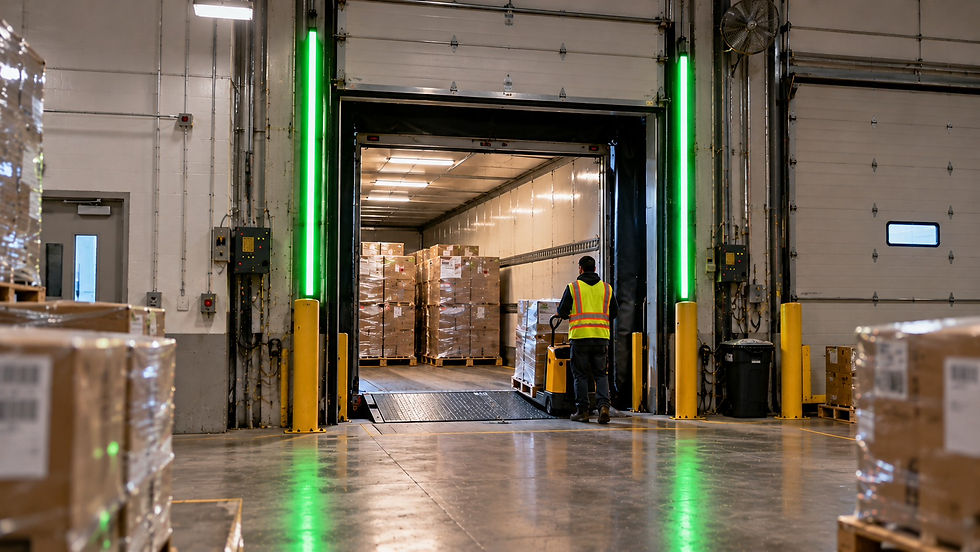
Once freight is on the dock, it typically needs to be moved to storage areas using a powered pallet jack or sit-down counterbalanced forklift. At the dock door threshold, pedestrian traffic (housekeeping staff, vendor reps, facility engineers) and forklift traffic converge. Overhead doors that lack active visual warning systems give no indication to a pedestrian approaching from the interior that a forklift is about to exit through that door.
High Turnover and Variable Staffing
Healthcare facilities have high rates of staff turnover in logistics and environmental services roles. New dock workers may not be fully trained on dock communication protocols, and contract staff (common in hospital settings) may have little familiarity with the specific facility layout. Passive safety measures like floor markings and static warning signs have limited effectiveness with staff who are unfamiliar with the space.
Overnight and Weekend Vulnerability
The dock hazard is highest precisely when staffing is thinnest. Most hospital loading docks are staffed at reduced levels during evening, overnight, and weekend shifts — the same times when after-hours deliveries and emergency supply runs are most likely to occur. Decisions that a dock supervisor would catch during the day go unchecked at night.
The Right Solution
The fundamental problem at a hospital loading dock is a communication gap. The truck driver doesn't know what's happening inside. The receiver doesn't know when the driver is about to move. Workers approaching the dock door don't know whether a forklift is about to come through. Standard verbal and hand-signal protocols fail at scale, fail at night, and fail when new or temporary staff are involved.

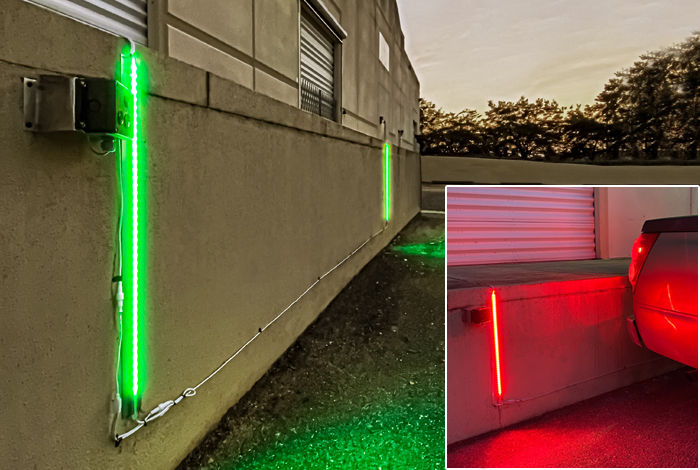
BrinkAlert's Loading Dock Backing Light Kit addresses this communication gap with a straightforward, high-visibility LED warning system that mounts directly to the door frame and connects to the facility's dock signal inputs truck restraints, dock lights, door switches, or control panels.
When a bay is active meaning a trailer is secured and work is in progress the LED strips on that bay's door frame illuminate in red. The signal is visible from across the dock, from the interior staging area, and from the parking apron outside. A driver returning to a cab can see at a glance whether the bay is still in an active work state. A receiver moving between bays can tell instantly which doors are safe to approach. A pedestrian walking through the staging area can see that Bay 2 is hot before stepping into the forklift path.
When work is complete, the dock door is closed, and the truck is cleared for departure, the signal transitions to green a positive confirmation that it's safe to move the trailer.
The system is passive from the user's perspective. There's nothing to remember, no button to push, no protocol to follow. The LEDs reflect the actual state of the dock automatically, based on the signal inputs they're connected to. That's what makes it effective in healthcare environments, where staffing varies, shift changes happen frequently, and formal dock communication protocols are often inconsistently followed.
For facilities where dock doors and interior corridor doors both pose hazard risks,
our Commercial Door Light Kit can be deployed at interior overhead doors adjacent to the dock staging area, giving forklift operators and pedestrians visibility into door status before making the approach.

What Facilities Get Wrong
Relying on Horn Systems Alone
Horn-based dock communication is better than no system at all, but it's inadequate as a primary safety control. Horns require active participation from both parties to work correctly. They're easily missed in noisy environments. And they provide no ongoing status indicator once the blast is heard (or not heard), there's no visual reminder of what the current state of the bay is. Hospitals that rely solely on horns are one missed blast away from a serious incident.
Treating the Dock as a Logistics Problem Rather Than a Safety Problem
Loading dock management is typically handled by materials management or facilities operations — not by safety managers or risk management. As a result, dock safety controls often get evaluated through a logistics lens (efficiency, throughput, cost) rather than a safety lens (hazard severity, incident probability, control hierarchy). LED visual warning systems are inexpensive relative to the cost of a single dock injury, but they often don't make it into the capital budget because nobody with safety authority is advocating for them.
Inconsistent Use of Truck Restraints
Truck restraints (wheel chocks or mechanical restraints) are a primary safeguard against premature trailer departure. At hospital docks, restraint use is often inconsistent particularly during high-volume delivery periods when receivers are working quickly. An LED warning system tied into the truck restraint status makes restraint use visible and creates an automatic confirmation that a restraint is engaged before declaring a bay active.
Ignoring Interior Forklift Hazards
Most hospital dock safety improvements focus on the exterior hazard (the truck moving before the dock is clear). The interior hazard a forklift exiting through a dock door or staging-area corridor door while pedestrian traffic is present often gets overlooked. Deploying warning lights at interior door openings adjacent to the dock is a low-cost extension of the safety system that addresses this gap.
Delaying Action After a Near-Miss
Hospital facilities typically document near-misses thoroughly, but the corrective action that follows is often administrative (a new protocol, a refresher training) rather than engineering-based (a physical change to the environment). Administrative controls are weak controls. Near-misses at loading docks are a reliable leading indicator of future injuries. Treating them as a documentation exercise rather than a trigger for engineering controls is a mistake that tends to end badly.
What Facility Managers Ask Us
Do BrinkAlert Loading Dock Backing Light Kits work with truck restraint systems we already have?
Yes. BrinkAlert's systems are designed to integrate with existing dock equipment including truck restraints, dock lights, and door controls from major manufacturers. The LED kit receives a signal input from whatever control your dock currently uses to communicate dock status, so there's no need to replace existing restraint hardware.
Our dock only has two or three active bays. Is a visual warning system still worth it?
Yes, arguably more so. Smaller docks often have less formal communication infrastructure and fewer staff to manage dock coordination. A two-bay dock staffed by one overnight receiver is exactly the environment where a visual signal system provides the greatest marginal safety benefit.
How difficult is installation on an existing dock door?
BrinkAlert Loading Dock Backing Light Kits are designed for retrofit installation on existing commercial dock doors. The LED strips mount to the dock and connect to the dock control signal or by a switch. Most installations can be completed in a few hours per bay by a commercial door dealer or electrical contractor. BrinkAlert works with a network of dealers who have experience with healthcare facility installations.
Are there specific OSHA standards that require dock warning lights?
OSHA's powered industrial truck standard (29 CFR 1910.178) requires safe operating conditions for forklifts, including provisions around hazardous areas and intersections. OSHA's general duty clause (Section 5(a)(1)) requires employers to protect workers from recognized hazards. Visual warning systems at loading docks are a recognized best practice for controlling the hazard of premature trailer departure and forklift-pedestrian conflict. While a specific standard may not mandate the exact form of the control, the absence of any active warning system is increasingly difficult to defend after an incident.
Can BrinkAlert systems be used in combination with our existing dock safety program?
Yes, and that's the recommended approach. BrinkAlert systems work alongside existing administrative controls (training, protocols, checklists) and personal protective equipment. They're an engineering control the most reliable layer in the hierarchy and they make existing administrative controls more effective by providing visual reinforcement.
What happens if the LED system fails?
BrinkAlert LED systems are designed for industrial durability. In the unlikely event of a system failure, the dock reverts to whatever manual communication protocol was in place before lighting installation. The visual system is an enhancement to existing safety practice, not a replacement for trained, attentive dock workers.
Hospital loading docks are high-risk work environments operating in a setting where risk management attention is understandably focused on the clinical side of the building. But the dock has real hazards, real OSHA exposure, and real injury potential and the staff who work there deserve the same standard of engineered safety controls as workers anywhere else in the facility.
The good news is that the fix is neither expensive nor complicated. LED visual warning systems from BrinkAlert give dock workers, truck drivers, and anyone passing through the staging area clear, always-on information about whether a bay is active. They work at 2 a.m. with one person on shift. They work when a new temp worker is running the dock. They work without any action required from the person who needs the information most.
For healthcare facilities looking to close a gap in their safety program that doesn't get enough attention, the loading dock is the right place to start.
Ready to Improve Safety at Your Facility?
BrinkAlert designs and manufactures LED visual warning systems for commercial loading docks, overhead doors, blind corners, and pedestrian conflict zones. Our systems are installed in hospitals, distribution centers, warehouses, fire stations, and industrial facilities across the country.