


Cold Storage Door Safety: Protecting Workers at Freezer and Cooler Entrances

Walk through any large food distribution center or cold storage facility and you'll notice something: the pace never stops. Pallet jacks, forklifts, and workers on foot move constantly through refrigerated zones, passing through heavy freezer and cooler doors dozens or hundreds of times each shift. The pressure to keep product moving is relentless.
That pressure creates a collision risk that's easy to underestimate until someone gets hurt.
Cold storage doors present a unique combination of hazards that set them apart from standard commercial doors. They're heavy. They cycle rapidly. Visibility at the threshold is often limited. And the environments on either side of the door are radically different; a warm staging area on one side, a near-freezing cooler or sub-zero freezer on the other. Workers and forklift operators don't always know what's coming through from the other direction.
For facility managers and safety managers in food processing, cold storage, and distribution, these doors deserve much more focused attention than they typically receive.
Why This Matters
Cold storage facilities are among the more hazardous work environments in the warehousing and distribution sector. The Bureau of Labor Statistics consistently identifies food manufacturing and warehousing as industries with elevated injury rates, and door-related incidents struck-by events, caught-between injuries, and forklift pedestrian collisions near entrances contribute meaningfully to that total.
The liability exposure is significant. When a worker is struck near a door threshold and the investigation reveals no warning system was in place, the facility faces both OSHA scrutiny and civil liability. OSHA's General Duty Clause (Section 5(a)(1)) requires employers to provide a workplace free from recognized hazards and a high-traffic door with no warning system, in a facility where near-misses have occurred, is exactly the kind of recognized hazard that can anchor a citation or a lawsuit.
Beyond liability, there's the human cost. Injuries at door thresholds tend to be serious. A worker struck by a forklift or crushed by a heavy door panel can face life-altering consequences. Lost productivity, workers' compensation costs, and the morale impact on a team that witnessed a traumatic incident all follow.
The good news: these incidents are largely preventable with the right warning systems in place.

The Safety Problem
Cold storage doors create hazards for several reasons that compound one another.
Visibility is limited by design
Refrigerated doors are thick and insulated. High-speed roll-up freezer doors and sliding panel doors obstruct sightlines to the other side until the door is nearly fully open. Workers approaching from either direction may be committed to passing through the threshold before they can see what's on the other side.
Traffic patterns conflict
In busy cold storage operations, the same door serves both pedestrian and powered industrial truck (PIT) traffic. A worker carrying product on foot and a counterbalance forklift loaded with pallets may approach the same door threshold at nearly the same time. Without any indication that the door is in use or that traffic is approaching from the other side, both parties rely on luck and situational awareness — neither of which is a reliable safety control.
Environmental contrast impairs awareness
Stepping from a warm dock environment into a freezer, or from a cold zone back out, can momentarily affect alertness and sensory perception. Fogged eyewear is common. Workers in cold storage environments wear bulkier PPE — gloves, insulated jackets, face covers — that can reduce peripheral vision and hearing. The standard cues that help people sense approaching hazards are degraded.
High door cycle rates increase exposure
An active cold storage door in a distribution center may cycle hundreds of times per shift. Each cycle is an opportunity for a conflict. The cumulative exposure over a day, a week, and a year is enormous.
Condensation and frost affect door surfaces and thresholds
Wet or icy floor conditions near the door can slow a worker's ability to stop quickly if they encounter an unexpected hazard in the opening.
Put these factors together and you have a situation where even careful, experienced workers face meaningful risk every time they pass through.
How BrinkAlert Commercial Door Light Kits Solve It
BrinkAlert's Commercial Door Light Kits (CDLK) are designed specifically for this problem: providing an unmistakable visual warning at the door threshold so that workers on both sides know when the door is in use before they commit to entering the opening.
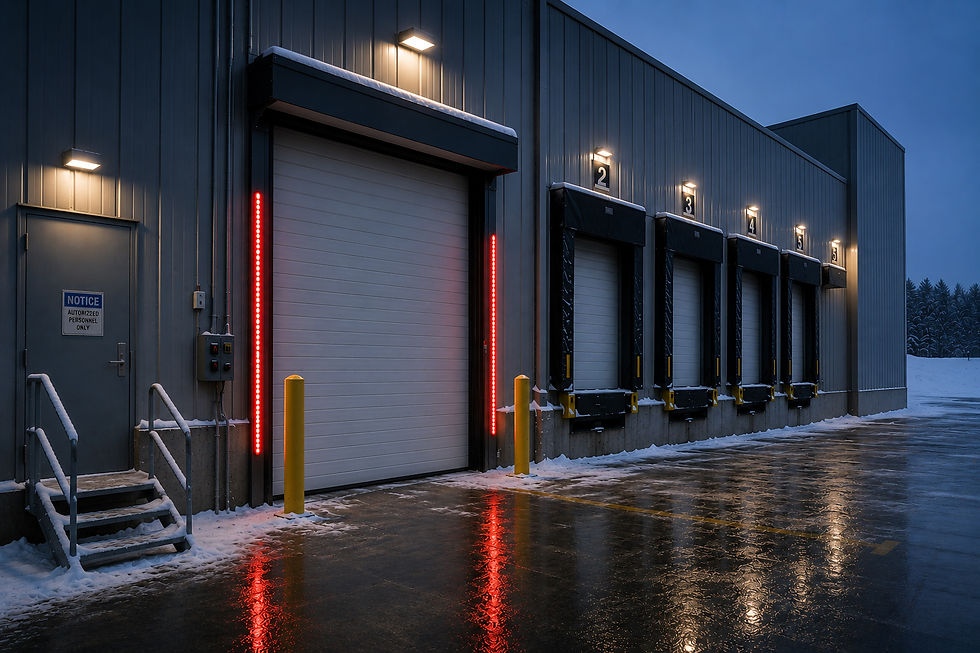
The system works simply and reliably. LED light strips are mounted on the door frame or adjacent wall on both sides of the door. When the door is opening or a vehicle is approaching, the lights activate (sensor sold separately) typically in red to signal "stop" or "door in use." When the path is clear, a green signal can indicate it is safe to proceed. The visual signal is bright enough to be seen across the approach zone, even in the reflective, high-contrast lighting conditions typical of cold storage environments.
This matters because it converts a decision that workers were making blind:
"Is anything coming through that door right now?" into a decision they can make with information.
Installation for cold storage environments
BrinkAlert Commercial Door Light Kits are built for industrial settings. The LED fixtures are durable and rated for the temperature cycling that occurs at the threshold of a refrigerated zone. Mounting is straightforward, and the systems can be wired to integrate with door sensors or motion detectors so that the lights activate automatically when the door begins to cycle or when a vehicle triggers an approach sensor.
For facilities running high-speed roll-up freezer doors, the BrinkAlert system can be configured to activate the moment the door receives an open command — providing the warning at the earliest possible moment, before the door itself has begun to move. This maximizes the warning time available to workers approaching from the other side.
Visibility across shift conditions
LED warning lights are effective in the variable lighting conditions common in cold storage bright staging areas transitioning to dimmer cooler interiors, condensation on fixtures, and artificial lighting that may shift in color temperature. The intensity and color of BrinkAlert's LED strips are chosen to be unmistakable even when a worker's attention is divided.
The warning is passive workers don't need to do anything different or remember to check a separate indicator. The visual cue is simply there, in the path they're already looking at, every time the hazard condition exists.
Real-World Application
Consider a regional frozen food distribution center operating three shifts, seven days a week. The facility handles inbound product from food manufacturers and outbound orders to grocery retail accounts. The cold storage zone is accessed through four heavy insulated doors connecting the freezer to the ambient staging area. Each door serves both pedestrian picking staff and electric pallet jacks operated by material handlers.
Before installing a warning system, the facility relied on workers to make eye contact and communicate verbally at the threshold. In practice, this was inconsistent. Workers wearing insulated hoods and ear protection often couldn't hear approaching pallet jacks. The staging area noise level made shouted warnings ineffective. Over 18 months, the facility logged three near-miss incidents at these doors and one recordable injury — a worker's foot struck by a pallet jack emerging from the freezer.
After installing BrinkAlert Commercial Door Light Kits at each of the four doors, the facility integrated the lights with existing door motion sensors. When a pallet jack triggers the sensor approaching the door from inside the freezer, the red lights on the staging-area side of the door activate. Workers staging nearby see the warning and wait clear of the threshold until the lights return to green.
In the twelve months following installation, the facility recorded zero door-threshold incidents. The safety manager noted that the system also changed behavior: workers who had developed habits of walking through quickly without checking began pausing at the threshold by reflex, simply because the visual cue was there.
Common Mistakes Facilities Make
Treating cold storage doors as a single-direction hazard
Many facilities install a warning system on only one side of the door — typically the side facing the main traffic area — and leave the other side unprotected. Workers approaching from inside the freezer have no indication of pedestrian traffic on the staging side. Warning systems should cover both approaches.
Relying exclusively on auditory warnings
Horn systems and beeper alerts can be effective in some settings, but cold storage PPE, ambient noise, and the frequency of warning sounds in a busy facility all reduce their effectiveness. Workers can become habituated to routine horn sounds and stop treating them as meaningful. Visual warnings are harder to tune out and are effective regardless of noise level or PPE.
Installing warning systems too close to the door opening
A warning light mounted directly on the door frame gives workers very little reaction distance. Effective placement puts the warning signal far enough into the approach zone that workers can see it and stop before they reach the threshold. The goal is to change behavior before the hazard zone, not at it.
Skipping warning systems on "low-traffic" doors
Facilities often prioritize the busiest door first and defer installation on secondary doors. In practice, incidents frequently occur on doors that staff perceive as lower-traffic, precisely because the habitual vigilance is lower there.
No integration with door automation
A warning light that requires a worker to manually activate it before passing through will not be activated consistently under production pressure. Systems should be automatic — triggered by the door cycle, a vehicle sensor, or a motion detector — so that the warning requires no behavioral change from workers already moving at production pace.
Frequently Asked Questions
Are there specific OSHA regulations that require warning lights on cold storage doors?
There is no OSHA standard that specifically mandates LED warning lights on refrigerated doors. However, OSHA's General Duty Clause requires employers to address recognized hazards, and OSHA 29 CFR 1910.178 governing powered industrial truck operations requires that pedestrian traffic be protected in areas where PITs operate. Facilities that have documented near-misses or incidents at door thresholds face heightened scrutiny under both of these provisions. Many safety professionals install visual warning systems as a practical control measure to address these obligations proactively.
Can BrinkAlert Commercial Door Light Kits operate in sub-zero freezer environments?
BrinkAlert products are built for industrial settings including cold storage applications. If you have specific temperature range requirements for a particular installation, contact BrinkAlert directly at sales@brinkalert.com to discuss the specifics of your environment.
How do these systems integrate with existing high-speed door automation?
BrinkAlert Commercial Door Light Kits can be wired to integrate with door control systems, motion sensors, and approach sensors. The light activation can be tied to the door's open command signal so that warnings appear before the door begins to move. Integration specifics depend on the existing door controller — the BrinkAlert team can provide guidance based on your door type and control system.
What's the difference between using BrinkAlert warning lights and installing convex mirrors?
Convex mirrors require workers to actively look at the mirror and correctly interpret what they see — they don't generate a warning, they just provide more visual information if used properly. In fast-paced production environments, mirrors are often not consulted consistently. Warning lights are active: they change state when a hazard condition exists and don't require any proactive behavior from workers to deliver their warning. Used together, mirrors and warning lights provide better coverage than either alone.
How long does installation typically take?
Installation time depends on the specific configuration, the number of doors, and whether the system is being integrated with existing door automation. A basic installation on a single door can typically be completed in a few hours. Multi-door projects with sensor integration will require more time. BrinkAlert systems are designed for straightforward installation by facility maintenance staff or electrical contractors familiar with low-voltage systems.
Do warning lights help with insurance and compliance documentation?
Yes. Installing a recognized safety control measure can help demonstrate that a potential hazard was identified and addressed. This may support workplace safety programs, internal documentation, insurance discussions, and compliance efforts. Facilities should document the installation, the hazard it addresses, and the training provided to workers on the meaning of the warning signals. Because regulatory requirements and legal obligations vary by facility and jurisdiction, consult your safety professional, insurance provider, or attorney regarding your specific compliance and liability requirements.
Cold storage doors concentrate multiple hazard factors in a single location: heavy doors, mixed pedestrian and vehicle traffic, limited visibility, and the sensory challenges of cold environments and protective gear. For food distribution centers, food processing facilities, cold storage warehouses, and any operation with refrigerated zones accessed by both workers on foot and powered equipment, these doors warrant a structured safety response. LED visual warning systems from BrinkAlert address the core problem directly: they give workers and operators the information they need, at the moment they need it, in a format they cannot miss. That's the difference between a facility that relies on workers to be consistently vigilant an unrealistic expectation in any high-throughput operation and a facility that has engineered the hazard out of the daily equation. The investment is modest. The protection it provides is durable, automatic, and effective across shift changes, seasons, and personnel turnover.
Ready to Improve Safety at Your Facility?
If your cold storage facility has doors where pedestrian and powered equipment traffic converge, BrinkAlert can help you select and configure the right warning system for your application. Reach out to the BrinkAlert team at sales@brinkalert.com or visit the CDLK page here to learn more about Commercial Door Light Kits and the full range of LED warning solutions for industrial environments.