


Aviation Hangar Door Safety: Why Aircraft Facilities Need LED Visual Warning Systems

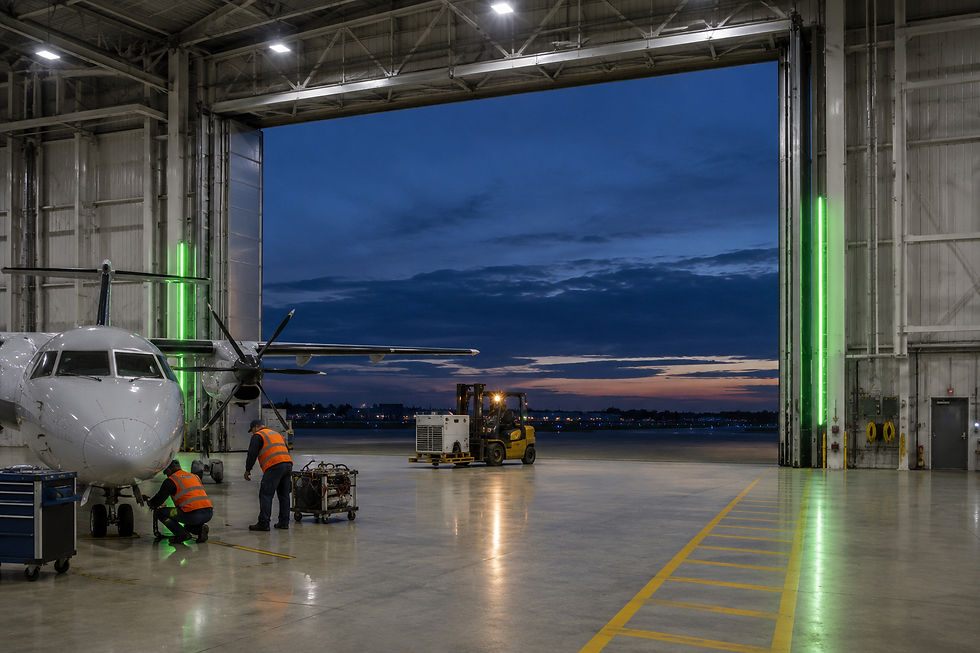
Aircraft hangars operate at a different scale than most industrial facilities. The doors alone bi-fold, hydraulic, sliding, or accordion-style can span 150 feet or more, weigh tens of thousands of pounds, and move on tracks at ground level where people and equipment are constantly working. In that environment, a miscommunication about door status doesn't just mean a near-miss. It can mean a grounded aircraft, a crushed ground vehicle, or a seriously injured technician.
Aviation facilities present a unique combination of hazards: enormous moving doors, high-value aircraft that cannot be easily moved, complex ground support equipment (GSE) activity, and maintenance workflows that often require people to be directly in the door's path. The same bay might have a mechanic on a lift inside the door, a tug driver pulling an aircraft through, and a line technician walking across the threshold all at the same time.
What most aviation facilities are missing is a simple, reliable way to communicate door status to everyone in the space. A horn or buzzer is easy to miss in a loud hangar environment. Flashing amber lights without context don't tell workers whether the door is opening, closing, or simply left running. LED visual warning systems designed for commercial overhead doors solve this problem directly and they're now being installed in aviation facilities nationwide.
Why This Matters
The stakes in an aviation hangar are higher than in a typical warehouse. A forklift striking a concrete wall costs you a repair bill. A door striking an aircraft nose cone can cost hundreds of thousands of dollars in damage, ground the aircraft for weeks, and trigger an FAA incident report. An injury to a line technician in a door path can result in OSHA recordables, workers' compensation claims, and serious liability exposure.
Beyond the financial risk, aviation facilities face scrutiny from multiple regulatory bodies. The FAA, OSHA, and local fire authorities all have jurisdiction depending on the type of facility and operation. Aircraft maintenance organizations (AMOs) certified under FAA Part 145 are subject to inspections that evaluate general safety practices, including door and access point controls. While there is no FAA-specific standard for visual door warnings, general OSHA requirements for industrial facilities including 29 CFR 1910.178 on powered industrial trucks operating near doorways apply fully.
The practical consequence: when an incident occurs at a hangar door, the question investigators ask is whether adequate visual warning was in place. A facility with no warning system, or only an audible horn, has a much harder time demonstrating that it took reasonable precautions.
The Safety Problem
Hangar doors present a distinct set of hazards that differ from standard warehouse overhead doors:
Scale and momentum. A bi-fold hangar door that spans 80 to 200 feet has enormous mass. Even at slow operating speeds, it carries enough momentum to cause severe equipment damage on contact. Unlike a standard overhead door that rises vertically, many hangar door designs swing, fold, or slide horizontally patterns of movement that workers may not instinctively track.
Ground-level travel paths. Many hangar door types operate on floor tracks. Those tracks run directly through the aircraft movement corridor, meaning forklifts, aircraft tugs, belt loaders, and fuel trucks cross the door's path as part of normal operations. Workers on foot cross those same tracks dozens of times per shift.
Visibility limitations inside the hangar. Large aircraft create extensive shadow zones. A technician working behind a wing, under a fuselage, or on an elevated maintenance stand may not have a clear sightline to the door. They cannot reliably see a door beginning to move, particularly during shift changes or in facilities where door cycles are not announced in advance.
High ambient noise. Hangar environments are loud. Auxiliary power units (APUs), ground power carts, compressed air tools, and general facility HVAC systems all contribute to a noise floor that makes audible warnings unreliable. A horn mounted at the door may simply not be heard by a technician 40 feet away, wearing hearing protection, working with pneumatic tools.
Multiple simultaneous operations. Unlike a single-purpose warehouse bay, hangars often support concurrent aircraft maintenance activities, ground operations, fueling, and parts delivery all in the same space, often with different supervisors and crews. Coordinating door cycles across these teams is difficult without a consistent visual communication system.
Aircraft movement timing. Pulling an aircraft into or out of a hangar requires precise coordination. The aircraft has limited clearance on each side, a tug driver who may have limited visibility of the full door perimeter, and a wing walker or ground handler who is positioned away from the door controls. A door that begins to move during an aircraft pull even a few inches can result in a strike.
How BrinkAlert Commercial Door Light Kits Solve It
BrinkAlert's Commercial Door Light Kit (CDLK) provides a continuous, color-coded visual indicator of door status that works alongside existing door control systems without requiring rewiring or integration with the door's native controller.
The system mounts LED strips directly on the door frame or structural columns adjacent to the hangar bay opening. When the door is closed and locked, the LEDs display solid red a clear signal that the door is engaged and should not be approached by aircraft or GSE. When the door begins to cycle, the LEDs flash or change to amber, giving everyone in the facility a real-time visual cue that movement is underway. When the door is fully open and the path is clear, the LEDs can display solid green.

This color-coded logic is immediately legible to anyone in the facility without training. Red/green visual language is already embedded in aviation ground operations pilots understand it, ground crews understand it, and maintenance technicians understand it. The CDLK extends that same intuitive logic to the door itself.
Key advantages for aviation facilities:
Visibility across large distances
LED strips mounted at hangar door height often 20 to 30 feet or more are visible from across the length of a wide hangar bay. A technician on the far side of a large aircraft can see the door status at a glance without needing to move to a sightline.
Redundancy with audible systems
The CDLK doesn't replace existing audible warnings it adds a visual layer that works in high-noise environments. Workers wearing hearing protection, using power tools, or standing behind aircraft can still get the door status signal.
No integration required with door electronics
The CDLK is wired to the door's existing limit switches or contact closures that detect open/closed status the same signals the door controller already uses. BrinkAlert's system reads those signals without requiring modification to the door's safety circuit or control logic.
Durable construction for hangar environments
Aviation hangars deal with temperature swings, high humidity, cleaning chemicals, and the mechanical vibration of large aircraft. BrinkAlert LED strips are built for industrial environments and can be mounted in locations that see regular use and maintenance traffic.
Scalable across multiple bays
A facility with six hangar bays can install individual CDLKs on each bay and wire them independently, giving maintenance supervisors and line crews accurate door status for every bay simultaneously.
Common Mistakes Aviation Facilities Make
1. Relying exclusively on audible warnings.
Horns and bells serve a purpose, but they're insufficient in high-noise environments. Most aviation maintenance facilities exceed 85 dB during active operations, which is the threshold at which hearing protection is required. Audible-only warning systems are designed for environments where workers can reliably hear them not hangars.
2. Treating the tug driver as the sole safety control.
In many facilities, the aircraft tug driver and wing walkers are expected to verify door clearance before every pull. That's a reasonable expectation, but it places all the safety burden on individuals who may have limited sightlines, may be focused on aircraft clearance rather than door status, and can be working under time pressure to meet a departure slot. Systematic visual warnings reduce dependence on any single person's attention.
3. No visual indication of door status between cycles.
Many hangar door systems only activate audible or visual warnings during the cycle itself while the door is actively moving. But a door that is stopped mid-travel, or one that failed to fully close, presents a hazard that isn't communicated by a warning that only fires during movement. A continuous status indicator (red when closed, green when open, amber when cycling) provides more complete information.
4. Installing warning lights too close to the door.
Proximity-mounted lights are only visible to workers near the door. In a large hangar where aircraft are often 50 to 100 feet from the door during maintenance, a warning light at track level is largely invisible. Mounting LED strips at height, on the door frame or structural columns, maximizes the visible range across the entire bay.
5. Skipping documentation for insurance and regulatory purposes.
Aviation facilities that install visual warning systems and don't document the installation — component specifications, mounting locations, wiring diagrams miss an important risk management step. Documented safety systems support insurance claims, FAA safety program audits, and OSHA defense if an incident occurs. Keep installation records on file.
Frequently Asked Questions
Q: Does the BrinkAlert Commercial Door Light Kit work with bi-fold and sliding hangar doors, or only standard overhead doors?
A: Yes. The CDLK is compatible with any door type that has limit switches or contact closures indicating open/closed status which includes bi-fold, horizontal sliding, accordion, and hydraulic hangar doors. The LED strips mount on the door frame or adjacent structure, independent of the door's mechanics. Contact BrinkAlert to discuss your specific door configuration.
Q: Are there FAA requirements for visual warning systems on hangar doors?
A: There is no FAA-specific regulation that mandates visual warning systems on hangar doors. However, OSHA general industry standards apply to aviation maintenance facilities, including requirements for safeguarding pedestrians in areas where powered industrial vehicles operate (29 CFR 1910.178). FAA Part 145 certification inspections also evaluate general safety practices. Visual warning systems support compliance posture even where they are not explicitly mandated.
Q: Can the CDLK be installed on hangar doors that are very large — say, 100 feet wide or more?
A: Yes. BrinkAlert LED strips can be installed in lengths appropriate to large door frames. For very wide hangar doors with multiple panels or folding sections, strips can be mounted at each panel joint and on the structural columns flanking the opening, ensuring visibility from multiple angles across the bay floor.
Q: What's the difference between a visual warning light and a safety interlock?
A: A safety interlock stops the door or locks it out when a trigger condition is met for example, a floor sensor that detects an obstruction. A visual warning light communicates door status but does not physically prevent movement. Both serve different roles. BrinkAlert's CDLK is a visual communication system, not an interlock. Many facilities use both: interlocks as a hard stop for detected obstructions, visual warnings as continuous status communication for everyone in the space.
Q: How difficult is the CDLK to install in an existing hangar?
A: Installation typically requires wiring the LED strips to the door's existing limit switches and mounting the strips on the door frame or structural columns. Most commercial door installers and facility electricians can complete the installation without specialized training. BrinkAlert provides wiring diagrams and technical support. For complex multi-bay hangars, it's worth having a door technician involved in the initial installation design.
Q: Can the system be tied into a facility-wide safety lighting or alarm system?
A: BrinkAlert's Universal LED Controller supports integration with facility control systems that can trigger LED output changes via standard electrical signals. For facilities with a centralized door control or dispatch system, this allows door status to be communicated both locally (at the bay) and potentially at a central display point.
Final Thoughts
Aircraft hangars are high-stakes environments. The combination of massive moving doors, high-value aircraft, complex ground operations, and high ambient noise creates conditions where standard safety practices audible warnings, verbal communication, individual worker attention are not enough on their own.
LED visual warning systems provide a passive, continuous, highly visible layer of door status communication that works regardless of noise levels, sightlines, or shift transitions.
Mounted at height on door frames and structural columns, they communicate red-amber-green door status to everyone in the hangar simultaneously without requiring radio calls, hand signals, or anyone remembering to make an announcement.
BrinkAlert's Commercial Door Light Kit is designed for exactly this kind of high-traffic, high-consequence industrial environment. It installs cleanly on existing door infrastructure, integrates with standard limit switches, and adds the visual communication layer that aviation maintenance facilities need.
Ready to Improve Safety at Your Facility?
If you manage a hangar, flight operations facility, or aviation maintenance organization and want to learn how BrinkAlert's Commercial Door Light Kit can improve door safety at your facility, contact the BrinkAlert team directly.
Email: sales@brinkalert.com
Phone: (786) 339-9840
We work with facility managers, safety officers, and commercial door installers to design warning system configurations that fit the specific layout and operation of your facility. Reach out to start a conversation.